I've been away and pretty busy but I wanted to do a quick note on Dell's Q3. This was obviously a strong rebound for Dell in terms of revenue and more importantly profits even though HP grew share faster than them. I think primarily this quarter their move to Opteron in servers has definitely helped them. I also think their focus on trying to move their higher margin products has helped somewhat. But long term I continue to remain concerned by their lack of new strategic direction.
Their growth in China also I think will come under threat over the next 3-4 quarters as Lenovo trains their sights on Dell. And HP will not be happy knowing that Dell is managing to grow in spite of the fact that they have wrenched the #1 spot from them. All in all, I think Dell will probably have a good Q4. But by Q1 Lenovo and HP will start to attack them in desktops & servers respectively. Which means unless HP gets their act together Dell does have a relative opportunity in the notebook business. I am doubtful their Q3 results were really helped by their move to Turion since that was much later in the quarter. I suspect what happened their is they had their sales people focus on selling up in what is a very rapidly growing category.
Thoughts everybody...?
Monday, November 27, 2006


Friday, November 17, 2006
Intel increases dividends starting Q107
Intel increases dividends
After announcing a Q406 dividend, which I discussed here:
http://sharikou180.blogspot.com/2006/09/intel-announces-dividend.html
To further raise the dividend is not the sign of a company worrying about their cash position. What's going on here? Something has happened to give the board confidence that they can not only afford a dividend, they can increase it.
After announcing a Q406 dividend, which I discussed here:
http://sharikou180.blogspot.com/2006/09/intel-announces-dividend.html
To further raise the dividend is not the sign of a company worrying about their cash position. What's going on here? Something has happened to give the board confidence that they can not only afford a dividend, they can increase it.
Wednesday, November 15, 2006
Nvidia making out with Intel - I called it in September
I had said back in September that Nvidia and HP would get more aligned with Intel post the ATI acquisition. The Nvidia piece of that has started to materialize.
http://www.nvidia.com/object/IO_37234.html
I'm thinking this is only the first step and there will be more to come between Nvidia and Intel. To read the original post, go here:
New Bed-fellows
So far this week that's 2 predictions come right - this and the demise of the PIC.
http://www.nvidia.com/object/IO_37234.html
I'm thinking this is only the first step and there will be more to come between Nvidia and Intel. To read the original post, go here:
New Bed-fellows
So far this week that's 2 predictions come right - this and the demise of the PIC.
Monday, November 13, 2006
PIC is dead - I called it in September
In their quarterly filing AMD cancelled PIC. Scroll down to page 32:
AMD Q3 filing
I called this back in September when I said the cash being spent behind the ATI deal would force Hector to review which projects he continues to fund and perhaps the PIC would disappear.
New Bed-fellows
(Scroll down the post)
The point is not PIC itself which has very little material impact on AMD"s revenues. The point really is that AMD will have to now start to manage cash and debt very carefully and they will not be able to invest in as many areas as they have been. The second message in here as that Hector's 50x15 vision becomes only rhetoric. Which is unfortunate for the people who could have benefitted from it...but that's life. In this case, they definitely lived up to their slogan of "Smarter Choice". Just it was the smarter choice for themselves this time round -:)
AMD Q3 filing
I called this back in September when I said the cash being spent behind the ATI deal would force Hector to review which projects he continues to fund and perhaps the PIC would disappear.
New Bed-fellows
(Scroll down the post)
The point is not PIC itself which has very little material impact on AMD"s revenues. The point really is that AMD will have to now start to manage cash and debt very carefully and they will not be able to invest in as many areas as they have been. The second message in here as that Hector's 50x15 vision becomes only rhetoric. Which is unfortunate for the people who could have benefitted from it...but that's life. In this case, they definitely lived up to their slogan of "Smarter Choice". Just it was the smarter choice for themselves this time round -:)
Thursday, November 09, 2006
The Doctor is making money off Intel
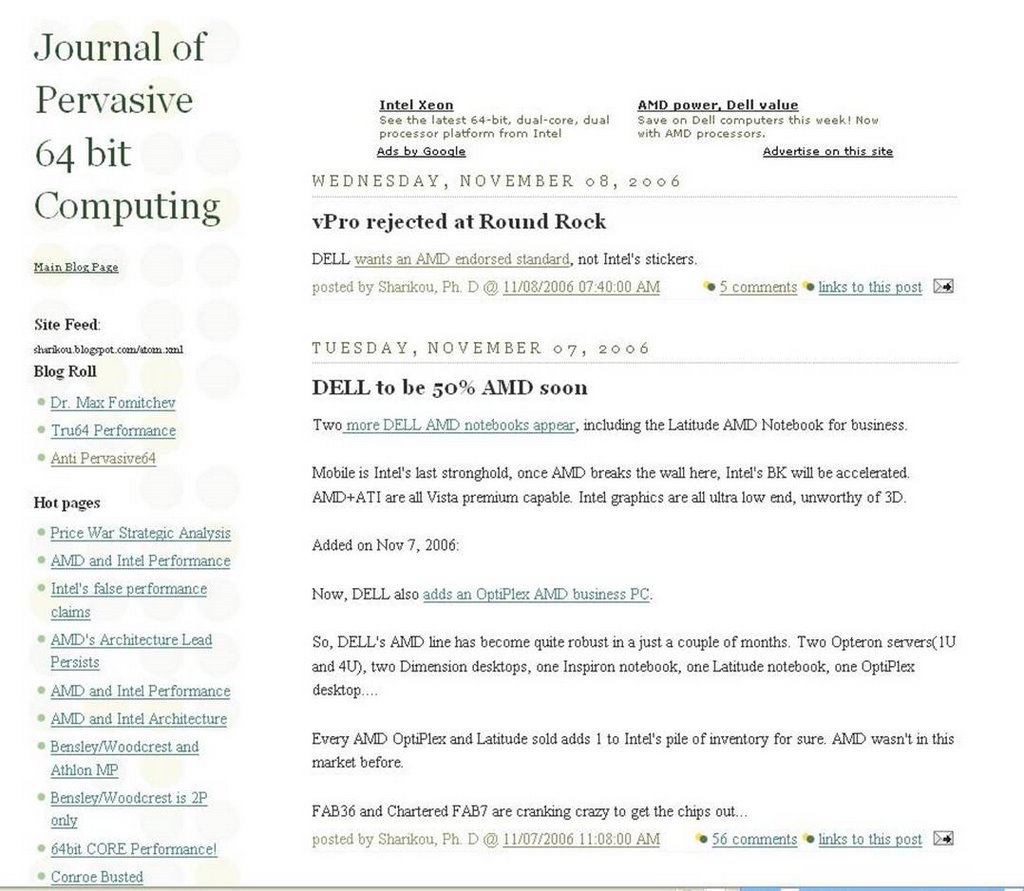
The good Doctor of Pervasive 64 bit Disinformation has started running Google ads. I have nothing against this. All power to him if he can make money writing what he writes best. However, what I cannot understand is that he has ads promoting Intel products on his page. Surely his ethics would prevent him promoting Intel's products since he believes they all deserve to be consigned to a landfill. I left him a post yesterday asking what was going on but he did not post my comment. Here's the screen grab:

See it for yourself:
http://sharikou.blogspot.com
-------------------------------------------------------
UPDATE
I tried clicking the ad links at the bottom of the page...
Link to article
...and for 3 out of 4 the first link on the subsequent Google ad page took me to Intel's web site. That's just hilarious man! I really hope the Doctor is getting a good laugh too...hopefully to the bank with all the money I hope he's making from Intel via Google.
See it for yourself:
http://sharikou.blogspot.com
-------------------------------------------------------
UPDATE
I tried clicking the ad links at the bottom of the page...
Link to article
...and for 3 out of 4 the first link on the subsequent Google ad page took me to Intel's web site. That's just hilarious man! I really hope the Doctor is getting a good laugh too...hopefully to the bank with all the money I hope he's making from Intel via Google.
Dell deploys Quad Core
Dell with Quad Core Xeons on day 1. That's some time to market and endorsement:
http://biz.yahoo.com/bw/061108/20061108005201.html?.v=1
This is where the rubber hits the road and all the talk about K8L disappears into thin air as the product still does not exist. At this point all the dudes who are fantasizing about how AMD's quad core will kick Intel's ass get a dose of reality. It doesn't matter if your architecture is superior. If the product isn't in the market you ain't selling it. By Q2 Intel will have introduced more flavours of quad core desktop parts and dropped prices significantly below 999$ which is the launch price. In Q2 (hopefully) or perhaps Q3 AMD will introduce their quad core part but will not be able to price it in the same range as Intel will have almost a 3 qtr advantage to stabilize yields and reduce manufacture costs on the part. AMD will then have to play catch up again as Intel begins 45nm late 2007 followed by new mArch in 2008.
On a seperate but related note, Apple introduces the new Macbook with Core 2 Duo.
http://www.apple.com/macbook/macbook.html
Welcome to the party. It's about to get interesting!
-----------------------------------------------------
UPDATE
The opening line was meant to be "Dell with Quad Core Xeons on MINUS day 1. That's some time to market and endorsement:"
The implication here is the official Clovertown launch is actually 14th Nov. Dell has jumped the gun and also jumped every other OEM. There's a message in here and it's a Dell message...not Intel or AMD. Dell needs to win in servers to drive their margins up. Specially since they are losing share to HP.
http://biz.yahoo.com/bw/061108/20061108005201.html?.v=1
This is where the rubber hits the road and all the talk about K8L disappears into thin air as the product still does not exist. At this point all the dudes who are fantasizing about how AMD's quad core will kick Intel's ass get a dose of reality. It doesn't matter if your architecture is superior. If the product isn't in the market you ain't selling it. By Q2 Intel will have introduced more flavours of quad core desktop parts and dropped prices significantly below 999$ which is the launch price. In Q2 (hopefully) or perhaps Q3 AMD will introduce their quad core part but will not be able to price it in the same range as Intel will have almost a 3 qtr advantage to stabilize yields and reduce manufacture costs on the part. AMD will then have to play catch up again as Intel begins 45nm late 2007 followed by new mArch in 2008.
On a seperate but related note, Apple introduces the new Macbook with Core 2 Duo.
http://www.apple.com/macbook/macbook.html
Welcome to the party. It's about to get interesting!
-----------------------------------------------------
UPDATE
The opening line was meant to be "Dell with Quad Core Xeons on MINUS day 1. That's some time to market and endorsement:"
The implication here is the official Clovertown launch is actually 14th Nov. Dell has jumped the gun and also jumped every other OEM. There's a message in here and it's a Dell message...not Intel or AMD. Dell needs to win in servers to drive their margins up. Specially since they are losing share to HP.
Wednesday, November 08, 2006
Whose CPU margins are better
A very quick note. There is some wild gesticulation from the AMD "fannies" that AMD's CPU margins and cost structures are better than Intel's based on some ridiculous calculations (which I have already pointed out are baseless) from my good friend the Doctor. Here's why this is inaccurate and just a bunch of hand-waving from the AMD fans:
1. In Q3, Intel and AMD's gross margins were almost identical. However, AMD's margins are only for the high margin business of CPUs while Intel's are for CPUs + other businesses with significantly lower margins like flash, chipsets, mobos, etc. Furthermore, businesses like flash are actually a drag on profits recording a 116 million $ loss in Q3. On a CPU revenue of 5.8 billion out of a total 8.7 billion Intel's CPU margins would be significantly higher than the ~50% it recorded.
2. If AMD's margins are so good, why is it that it's net income for Q3 is only 1/10th of Intel's in spite of the fact that it's CPU revenues and market share are roughly 1/4th Intel's. And this is after Intel's net income being reduced by ~740 million due to Flash and Other losses.
The answer to both these is simple. Not only is Intel's cost structure better, it's ASPs are higher in the CPU business.
1. In Q3, Intel and AMD's gross margins were almost identical. However, AMD's margins are only for the high margin business of CPUs while Intel's are for CPUs + other businesses with significantly lower margins like flash, chipsets, mobos, etc. Furthermore, businesses like flash are actually a drag on profits recording a 116 million $ loss in Q3. On a CPU revenue of 5.8 billion out of a total 8.7 billion Intel's CPU margins would be significantly higher than the ~50% it recorded.
2. If AMD's margins are so good, why is it that it's net income for Q3 is only 1/10th of Intel's in spite of the fact that it's CPU revenues and market share are roughly 1/4th Intel's. And this is after Intel's net income being reduced by ~740 million due to Flash and Other losses.
The answer to both these is simple. Not only is Intel's cost structure better, it's ASPs are higher in the CPU business.
Sunday, November 05, 2006
Channel unhappy with AMD
First - I have been pretty busy last couple of weeks to post regularly to the blog. Instead, I've been trying to ensure comments get through and I can respond. Hopefully things will ease out this week and I'll be able to finish my Q3 take which has been in draft for some time. This post isn't a deep analysis. It's more to confirm the DIY channel frustration with AMD for shorting them on supply is starting to become visible with more re-sellers becoming vocal:
http://www.crn.com.au/story.aspx?CIID=67571&src=site-marq
http://www.theinquirer.net/default.aspx?article=35457
The impact of this to AMD is if this festers for another 2 quarters then it will take them a long time to win back channel trust/confidence even if supply does normalize. Those who work in the industry will understand this. Those who don't will issue blistering comments that they day AMD's supply problem is resolved, the channel will come running back to them. But that's not the way it happens. For the small guy round the corner, he feels screwed when either AMD or Intel give deeper discounts or supply preference to the big OEMs. It makes it incredibly hard for them to compete and watching a sale walk away because you didn't have the product is like seeing food on the table disappear. Intel has taken 2 years to recover from the chipset shortage. If this precipitates for AMD, they will lose a significant amount of channel momentum which will hurt them late next year once 65nm is ramped.
http://www.crn.com.au/story.aspx?CIID=67571&src=site-marq
http://www.theinquirer.net/default.aspx?article=35457
The impact of this to AMD is if this festers for another 2 quarters then it will take them a long time to win back channel trust/confidence even if supply does normalize. Those who work in the industry will understand this. Those who don't will issue blistering comments that they day AMD's supply problem is resolved, the channel will come running back to them. But that's not the way it happens. For the small guy round the corner, he feels screwed when either AMD or Intel give deeper discounts or supply preference to the big OEMs. It makes it incredibly hard for them to compete and watching a sale walk away because you didn't have the product is like seeing food on the table disappear. Intel has taken 2 years to recover from the chipset shortage. If this precipitates for AMD, they will lose a significant amount of channel momentum which will hurt them late next year once 65nm is ramped.
Thursday, October 26, 2006
Dell launches sub 500$ AMD notebooks
I want to start by saying this is NOT GOOD FOR AMD.
http://www.digitimes.com/systems/a20061024PR211.html (this link now needs a log in)
http://dailytech.com/article.aspx?newsid=4706
If you look at my posts/comments over the last few days I have been saying Dell is dragging AMD down the price stack and squeezing them on pricing thus hurting margins. I am now convinced this is what is happening. I know I said yesterday that AMD needs to do some discounting on notebooks to gain entry into new customers to break Intel's stronghold in the notebook segment but this sounds like they are going to start hurting themselves.
I repeat, if AMD was not running tight on capacity then it's ok to do these kinds of deals to keep the factories loaded. But considering the reports that they are starving teh channel on desktop parts for the last few months and now the TW ODMs are saying AMD may be short of mobile parts, surely they could have made some of these a higher bin and sold them for better margins at some of the other customers they are gaining entry into. Dell has no strategy and is heading into a death spiral of becoming commoditized but it's tragic they are dragging AMD down. As much as I think Intel is going to gain the momentum for the next 6-9 months, I think AMD is now throwing away the strategic leverage they have built so successfully in the market place with a good range of customers through these deals with Dell.
UPDATE
Dell's new AMD based notebooks are not sub 500$. In fact, a quick spec comparision shows they may actually be more expensive than an equivalent Centrino Duo. We probably need to wait 1-2 quarters to really see how this plays out.
http://www.digitimes.com/systems/a20061024PR211.html (this link now needs a log in)
http://dailytech.com/article.aspx?newsid=4706
If you look at my posts/comments over the last few days I have been saying Dell is dragging AMD down the price stack and squeezing them on pricing thus hurting margins. I am now convinced this is what is happening. I know I said yesterday that AMD needs to do some discounting on notebooks to gain entry into new customers to break Intel's stronghold in the notebook segment but this sounds like they are going to start hurting themselves.
I repeat, if AMD was not running tight on capacity then it's ok to do these kinds of deals to keep the factories loaded. But considering the reports that they are starving teh channel on desktop parts for the last few months and now the TW ODMs are saying AMD may be short of mobile parts, surely they could have made some of these a higher bin and sold them for better margins at some of the other customers they are gaining entry into. Dell has no strategy and is heading into a death spiral of becoming commoditized but it's tragic they are dragging AMD down. As much as I think Intel is going to gain the momentum for the next 6-9 months, I think AMD is now throwing away the strategic leverage they have built so successfully in the market place with a good range of customers through these deals with Dell.
UPDATE
Dell's new AMD based notebooks are not sub 500$. In fact, a quick spec comparision shows they may actually be more expensive than an equivalent Centrino Duo. We probably need to wait 1-2 quarters to really see how this plays out.
Wednesday, October 25, 2006
This is kind of funny
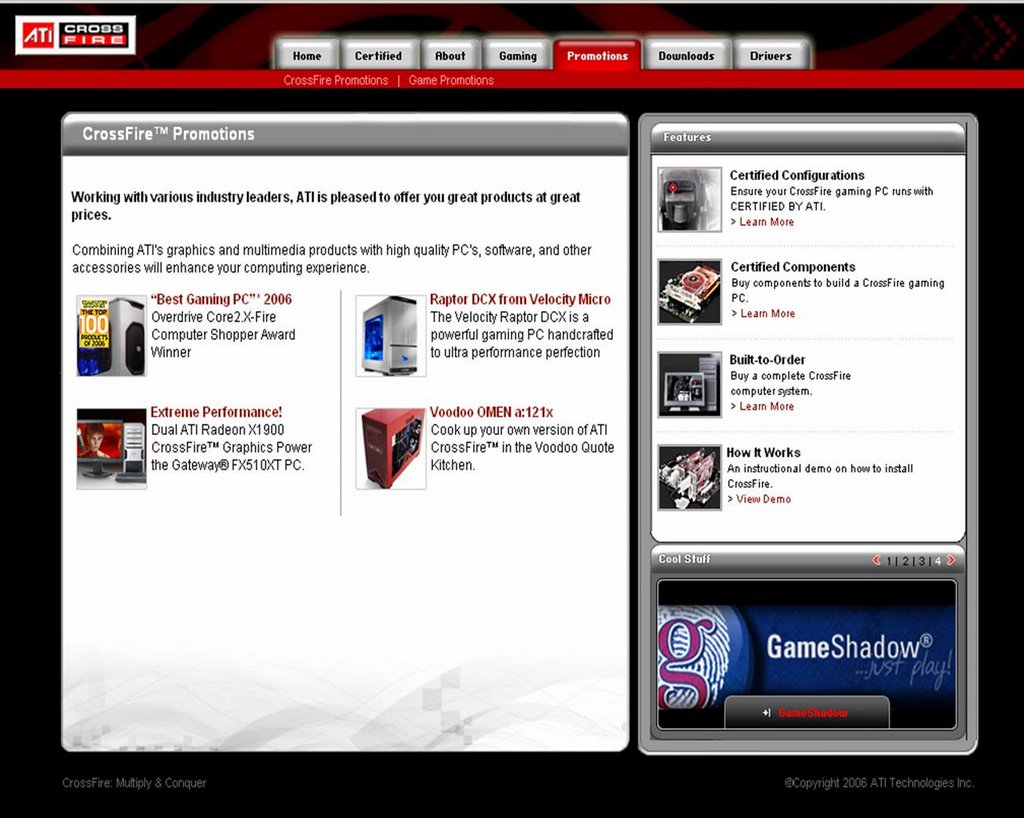
AMD which has just acquired ATI is promoting Crossfire systems with 3 out of 4 being Core 2 systems as best in class for gaming. I screen grabbed them before they get removed...


What makes this really funny is this is not on the ATI site but on the AMD site:
http://ati.amd.com/technology/crossfire/promotions.html
I wonder how quickly this comes down? Someone is getting a flamer in their e-mail when they get into work tomorrow!



What makes this really funny is this is not on the ATI site but on the AMD site:
http://ati.amd.com/technology/crossfire/promotions.html
I wonder how quickly this comes down? Someone is getting a flamer in their e-mail when they get into work tomorrow!
AMD Earnings - a quick note
I want to move past the earnings announcements quickly cos they're stale news and I've taken too long to get to this. Hence, just a quick note on AMD:
1. Overall, their quarter came in on track more or less as I'd predicted including the fact they'd have a better quarter of it than Intel financially. The market share discussion also sees some light with the following assessment from Mercury Research - that both gained share from Via but Intel gained 3 points of share while AMD gained 1 point. The key here is AMD's leaps in market share are abating.
Q3 06 Market Share
2. The inventory issue (up by 15%) is worrying and my assessment is that this build up is really a result of Dell not being able to sell everything that was built for them...or just having the wrong SKUs.
3. Margins took a substantial beating down ~5.5%. A few things happened here. First, AMD's growth in servers slowed down relative to the pace they've been managing past few quarters due to Woodcrest. Those margins were allowing them to sell client parts (desktop specifically) at a large discount to gain share. Second, Intel competitive pricing really hit them and they had to take big price drops in the desktop segment which is where they have strength after server. Third, they are chasing low margin deals like Dell to secure entry into new customers like Dell and the PRC OEMs.
4. Unit volume growth was high but overall market share gain was just 1%. Intel took 3% - all of it from Via. I'd also predicted that they would do everything to keep their factories full and it looks like they did.
5. They are clearly short-changing the channel on supply and price competitiveness and this is a chink in their armour that will hurt them over the next few quarters.
Looking forward, AMD didn't provide much in the way of guidance. My thoughts:
- It is crucial for them to win back Opeteron share where they are losing to Woodcrest. I suspect they think Dell will help them do that but you cannot have Woodcrest grow to 40% of the DP market by unit and assume it's all the low end of the market from a system pricing POV.
- They should hold desktop pricing even if it means losing share and hope pricing stabilizes as Intel & AMD have said it might.
- Mobile - they should be willing to drop price in this segment to gain entry into new customers before Intel launches Santa Rosa. Frankly, even though AMD claims a 50% sequantial growth in mobile QoQ, considering the small base they have this is probably not as impressive as it sounds when you think the mobile market is growing at 20-30%. If they hope to dent Intel's stranglehold on this high margin segment they must be willing to make some trade offs.
Overall, looking into Q4 I think AMD still has it's job cut out. They will reap the benefits on cost and hence margins moving to 65nm but will be negated by their need to sustain market share. I would not be surprised if Intel extended it's Oct 22 price drop beyond low end desktop SKUs if required to keep AMD on the defensive. They need to gain market share because adjusting inventory to customer needs is easier said than done so that optimization they talk about may or may not happen. The incremental 60 million worth inventory accumulated this qtr if they've built the wrong product is going to either have to be sold or written off. Either way, it's going to hurt. Operating cash is important because they now have an ATI acquisition to pay debt on. AMD has a dilemma pulling them in two opposite directions. I suspect in Q4 they will actually cede share to hold pricing and margins. While everyone is focussed on AMD starting 65nm shipments, Intel too is increasing their 65nm and reducing 90nm every day so the battle for cost efficiency is tough...specially since the Core products have smaller die sizes.
With nothing left of Via, next quarter will truly tell who is gaining share and who is losing it. I still predict AMD will lose share and Intel will gain it. Remember, 3% of the remaining market is more than 1% in absolute volume terms. Momentum is swinging back to Intel and Q4 will show us that.
1. Overall, their quarter came in on track more or less as I'd predicted including the fact they'd have a better quarter of it than Intel financially. The market share discussion also sees some light with the following assessment from Mercury Research - that both gained share from Via but Intel gained 3 points of share while AMD gained 1 point. The key here is AMD's leaps in market share are abating.
Q3 06 Market Share
2. The inventory issue (up by 15%) is worrying and my assessment is that this build up is really a result of Dell not being able to sell everything that was built for them...or just having the wrong SKUs.
3. Margins took a substantial beating down ~5.5%. A few things happened here. First, AMD's growth in servers slowed down relative to the pace they've been managing past few quarters due to Woodcrest. Those margins were allowing them to sell client parts (desktop specifically) at a large discount to gain share. Second, Intel competitive pricing really hit them and they had to take big price drops in the desktop segment which is where they have strength after server. Third, they are chasing low margin deals like Dell to secure entry into new customers like Dell and the PRC OEMs.
4. Unit volume growth was high but overall market share gain was just 1%. Intel took 3% - all of it from Via. I'd also predicted that they would do everything to keep their factories full and it looks like they did.
5. They are clearly short-changing the channel on supply and price competitiveness and this is a chink in their armour that will hurt them over the next few quarters.
Looking forward, AMD didn't provide much in the way of guidance. My thoughts:
- It is crucial for them to win back Opeteron share where they are losing to Woodcrest. I suspect they think Dell will help them do that but you cannot have Woodcrest grow to 40% of the DP market by unit and assume it's all the low end of the market from a system pricing POV.
- They should hold desktop pricing even if it means losing share and hope pricing stabilizes as Intel & AMD have said it might.
- Mobile - they should be willing to drop price in this segment to gain entry into new customers before Intel launches Santa Rosa. Frankly, even though AMD claims a 50% sequantial growth in mobile QoQ, considering the small base they have this is probably not as impressive as it sounds when you think the mobile market is growing at 20-30%. If they hope to dent Intel's stranglehold on this high margin segment they must be willing to make some trade offs.
Overall, looking into Q4 I think AMD still has it's job cut out. They will reap the benefits on cost and hence margins moving to 65nm but will be negated by their need to sustain market share. I would not be surprised if Intel extended it's Oct 22 price drop beyond low end desktop SKUs if required to keep AMD on the defensive. They need to gain market share because adjusting inventory to customer needs is easier said than done so that optimization they talk about may or may not happen. The incremental 60 million worth inventory accumulated this qtr if they've built the wrong product is going to either have to be sold or written off. Either way, it's going to hurt. Operating cash is important because they now have an ATI acquisition to pay debt on. AMD has a dilemma pulling them in two opposite directions. I suspect in Q4 they will actually cede share to hold pricing and margins. While everyone is focussed on AMD starting 65nm shipments, Intel too is increasing their 65nm and reducing 90nm every day so the battle for cost efficiency is tough...specially since the Core products have smaller die sizes.
With nothing left of Via, next quarter will truly tell who is gaining share and who is losing it. I still predict AMD will lose share and Intel will gain it. Remember, 3% of the remaining market is more than 1% in absolute volume terms. Momentum is swinging back to Intel and Q4 will show us that.
Monday, October 23, 2006
Comparision points
Folks - I'm in the process of my analysis on the Q3 earnings but stopped to make a point on how everyone is using YOY (year on year) or QOQ (qtr on qtr) results selectively. They both serve different purposes and with some astute (non-biased) interpretation can be used together to give you a good read. However, don't ignore the changes in the marketplace:
1. AMD will start using 65nm which will give them cost and capacity boosts.
2. Core 2 has smaller die sizes than Netburst...and even some of AMD's line up.
3. Intel has a brand new top-to-bottom product line that kicks ass. AMD does not have a response till mid 2007.
4. AMD has a huge new customer - Dell. But Dell is losing share and more importantly their strategic direction.
5. Intel also has a new customer - Apple. Who is growing their own PC client columes at a fast clip. But is probably getting mobile parts significantly cheaper than anyone else from Intel.
6. AMD has a new strategic acquisition - ATI. But it is unlikely we will see a corporate platform from them in 2007. But they will now have the ability to make life very difficult for Intel in the short term on the integrated graphics business through bundling and pricing. Also, ATI has a strong brand...I'd venture to say perhaps even stronger than AMD in the high end consumer space.
Bottom-line, there isn't a deciding factor to who wins. Some well rounded analysis will engender some good discussion. A single data point (i.e. gross margin) doesn't mean victory for one side or the other (in this case I mean the pro Intel/AMD folks).
I'll be back shortly with my look at the Intel earnings.
1. AMD will start using 65nm which will give them cost and capacity boosts.
2. Core 2 has smaller die sizes than Netburst...and even some of AMD's line up.
3. Intel has a brand new top-to-bottom product line that kicks ass. AMD does not have a response till mid 2007.
4. AMD has a huge new customer - Dell. But Dell is losing share and more importantly their strategic direction.
5. Intel also has a new customer - Apple. Who is growing their own PC client columes at a fast clip. But is probably getting mobile parts significantly cheaper than anyone else from Intel.
6. AMD has a new strategic acquisition - ATI. But it is unlikely we will see a corporate platform from them in 2007. But they will now have the ability to make life very difficult for Intel in the short term on the integrated graphics business through bundling and pricing. Also, ATI has a strong brand...I'd venture to say perhaps even stronger than AMD in the high end consumer space.
Bottom-line, there isn't a deciding factor to who wins. Some well rounded analysis will engender some good discussion. A single data point (i.e. gross margin) doesn't mean victory for one side or the other (in this case I mean the pro Intel/AMD folks).
I'll be back shortly with my look at the Intel earnings.
Sunday, October 22, 2006
Intel Q3 06 earnings analysis
Been busy this weekend and just able to grab a little time to listen to the earnings properly:
1. Server revenue, double digit unit growth and ASP growth - this is a very healthy sign. As I had said earlier, Intel is starting to win back their big losses in servers...specially in the DP space. Combine that with the fact that Woodcrest is already 40% of the server market by volume in 3 months (as announced at IDF first). However, the impact of this may be felt less to AMD if they decide to retain premium pricing on Opteron and really focus on the MP server market where margins are higher.
2. Mobile too had record shipments - at the cost of desktops which continue do decline as a share of overall market. Not unexpected as Intel does have a significant lead over AMD in mobile. Will be interesting to see the impact of Dell in this space in Q4. But with Merom ramping incredibly fast considering it would be the bulk of the volume in the Core 2 6 million units shipped, feels like they're in good shape here.
3. Inventory in microprocessors down QoQ. Chipsets and flash were up. Overall inventory was ~4.45 billion...a gain of 120 million over Q2. They also took a 100 million $ write off. But most importantly, all the WIP is 65nm. Which means the transition is happening quite rapidly.
4. Q4 outlook - revenue between 9.1 to 9.7 billion. Gross margin around 50%. On track to hit 95,000 heads from 102,500. About 500 million savings on capital spending and R&D against the original plan. MG&A costs to be about flat QoQ even as revenue increases. Overall, it looks like the effects of the re-structure are kicking in to the upside. The worrying thing here is the gross margin staying at 50%. Which means either the price war will continue or they will get hit with the 65nm and 45nm transition costs. Since the indication from Bryant is they expect to see prices firm n Q4, this is probably the former.
On the face of it, the qtr came through pretty much as I expected. Otellini believes they gained overall share but as I said earlier, we'll have to wait for Gartner/IDC to confirm. The most critical piece in here is servers and the Woodcrest ramp. The more share they re-gain here, the harder they hit AMD's margins and hence free cash which is very important as AMD takes incremental debt to fund the ATI acquisition. The price war should stabilize in Q4. Obviously Intel had planned for this when they forecast their margin at 49%. Overall, it feels like Intel is holding in mobile, winning back in servers and losing in desktop. While it's important to win back the desktop market just because of the sheer size, I think we will see the true impact of the price drops and the Core 2 introduction in Q4 due to the lack of lower cost motherboards.
My nett take away is the qtr went as planned. Woodcrest is the bright spot and some marginal upside in terms of revenue but nothing to write home about. A concern on margins for Q4 and the discussion on share still up in the air as Otellini claims they gained overall share and it isn't clear from a quick glance at AMD's call whether they believe they gained any. However, I'll be reviewing that in detail next and will see if we can call it. For now, Intel needs to stay the course and focus on ramping Core 2 desktop, get the right chipsets/boards into the channels and help their OEM customers get off to a quick start as they introduce products this quarter for Christmas.
I'll be reviewing AMD's results next and will be able to figure out what I think Q4 will look like based on that.
1. Server revenue, double digit unit growth and ASP growth - this is a very healthy sign. As I had said earlier, Intel is starting to win back their big losses in servers...specially in the DP space. Combine that with the fact that Woodcrest is already 40% of the server market by volume in 3 months (as announced at IDF first). However, the impact of this may be felt less to AMD if they decide to retain premium pricing on Opteron and really focus on the MP server market where margins are higher.
2. Mobile too had record shipments - at the cost of desktops which continue do decline as a share of overall market. Not unexpected as Intel does have a significant lead over AMD in mobile. Will be interesting to see the impact of Dell in this space in Q4. But with Merom ramping incredibly fast considering it would be the bulk of the volume in the Core 2 6 million units shipped, feels like they're in good shape here.
3. Inventory in microprocessors down QoQ. Chipsets and flash were up. Overall inventory was ~4.45 billion...a gain of 120 million over Q2. They also took a 100 million $ write off. But most importantly, all the WIP is 65nm. Which means the transition is happening quite rapidly.
4. Q4 outlook - revenue between 9.1 to 9.7 billion. Gross margin around 50%. On track to hit 95,000 heads from 102,500. About 500 million savings on capital spending and R&D against the original plan. MG&A costs to be about flat QoQ even as revenue increases. Overall, it looks like the effects of the re-structure are kicking in to the upside. The worrying thing here is the gross margin staying at 50%. Which means either the price war will continue or they will get hit with the 65nm and 45nm transition costs. Since the indication from Bryant is they expect to see prices firm n Q4, this is probably the former.
On the face of it, the qtr came through pretty much as I expected. Otellini believes they gained overall share but as I said earlier, we'll have to wait for Gartner/IDC to confirm. The most critical piece in here is servers and the Woodcrest ramp. The more share they re-gain here, the harder they hit AMD's margins and hence free cash which is very important as AMD takes incremental debt to fund the ATI acquisition. The price war should stabilize in Q4. Obviously Intel had planned for this when they forecast their margin at 49%. Overall, it feels like Intel is holding in mobile, winning back in servers and losing in desktop. While it's important to win back the desktop market just because of the sheer size, I think we will see the true impact of the price drops and the Core 2 introduction in Q4 due to the lack of lower cost motherboards.
My nett take away is the qtr went as planned. Woodcrest is the bright spot and some marginal upside in terms of revenue but nothing to write home about. A concern on margins for Q4 and the discussion on share still up in the air as Otellini claims they gained overall share and it isn't clear from a quick glance at AMD's call whether they believe they gained any. However, I'll be reviewing that in detail next and will see if we can call it. For now, Intel needs to stay the course and focus on ramping Core 2 desktop, get the right chipsets/boards into the channels and help their OEM customers get off to a quick start as they introduce products this quarter for Christmas.
I'll be reviewing AMD's results next and will be able to figure out what I think Q4 will look like based on that.
Thursday, October 19, 2006
Come back on the weekend
I'm still kind of tied up so don't have time to do an in depth analysis on Intel's earnings right now. A couple of things that caught my attention:
1. They exceeded targets slightly which was kind of in line with my overall prediction that they would be on track to hit their target. They exceeded the mid point by 100 mln $ which is ok. But the bigger take away is Intel is focussed on executing again and we will begin seeing mometum return to them in Q4.
2. Market share - Otellini is now reserving market share comments till folks like Gartner/IDC confirm in 2-3 months. I guess he learned his lesson from the Q1 fiasco not to trust his sales guys on this number. He did however say he believed they gained market share in DP server (which is the volume) with Wodcrest. Let's see if Hector provides an indication or we'll have to wait some more for this data.
3. Q4 gross margins - this was the most disappointing piece that margins would remain around 50%. This either means the price war will continue or incremental costs in the factory...possibly due to the 45nm costs kicking in. There was some discussion on this during the analysts call but I didn't have time to hear it completely.
Come back on the weekend. I'll be reviewing Intel and AMD's results in some more detail. Meanwhile, I've had to help Sharikou by correcting some basic flaws in his calculations on capacity and cash flows.
My comment on capacity can be found far down here:
http://sharikou.blogspot.com/2006/10/charlie-showed-some-wisdom.html
My comment on cash flows will show up here if the post is authorized. In all fairness, I think only one of my posts was not put up so I don't want to make it appear like all my comments are being filtered:
http://sharikou.blogspot.com/2006/10/another-look-at-intels-balance-sheet.html
Hopefully, see ya on the weekend.
1. They exceeded targets slightly which was kind of in line with my overall prediction that they would be on track to hit their target. They exceeded the mid point by 100 mln $ which is ok. But the bigger take away is Intel is focussed on executing again and we will begin seeing mometum return to them in Q4.
2. Market share - Otellini is now reserving market share comments till folks like Gartner/IDC confirm in 2-3 months. I guess he learned his lesson from the Q1 fiasco not to trust his sales guys on this number. He did however say he believed they gained market share in DP server (which is the volume) with Wodcrest. Let's see if Hector provides an indication or we'll have to wait some more for this data.
3. Q4 gross margins - this was the most disappointing piece that margins would remain around 50%. This either means the price war will continue or incremental costs in the factory...possibly due to the 45nm costs kicking in. There was some discussion on this during the analysts call but I didn't have time to hear it completely.
Come back on the weekend. I'll be reviewing Intel and AMD's results in some more detail. Meanwhile, I've had to help Sharikou by correcting some basic flaws in his calculations on capacity and cash flows.
My comment on capacity can be found far down here:
http://sharikou.blogspot.com/2006/10/charlie-showed-some-wisdom.html
My comment on cash flows will show up here if the post is authorized. In all fairness, I think only one of my posts was not put up so I don't want to make it appear like all my comments are being filtered:
http://sharikou.blogspot.com/2006/10/another-look-at-intels-balance-sheet.html
Hopefully, see ya on the weekend.
Saturday, October 14, 2006
A few days of silence
I'm going to be away and kind of busy for a few days. May not get to post but will definitely make time to come back and look at Intel's Q3 results on the 17th. I will however check in and ensure comments get through. Till then, remember my prediction:
Intel will regain market share and momentum (share + margins) in Q4. If you wanted my advice, I would have told you to buy Intel at 17$. Now, buy AMD when it goes below 22 and hold till they re-gain traction. Remember - I'm not qualified to give you this kind of advice and you are not expected to take it. But hey...it's the Internet and heaven knows what other kooky things you may have been learning on it.
Intel will regain market share and momentum (share + margins) in Q4. If you wanted my advice, I would have told you to buy Intel at 17$. Now, buy AMD when it goes below 22 and hold till they re-gain traction. Remember - I'm not qualified to give you this kind of advice and you are not expected to take it. But hey...it's the Internet and heaven knows what other kooky things you may have been learning on it.
Subscribe to:
Posts (Atom)